
For Dr Navid Freidoonimehr, engineering starts with curiosity and a fascination with how things work.
“I’ve always been fascinated by how the human body works,” he says. “There’s so much we can learn from it.”
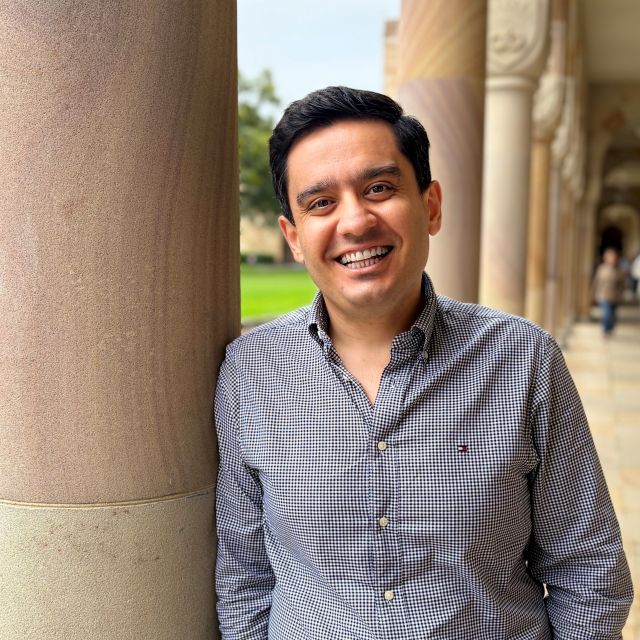
A lecturer and researcher in UQ’s School of Mechanical and Mining Engineering, Navid’s work sits at a compelling intersection - fluid mechanics and biomedical engineering. His research bridges two worlds helping to answer fundamental engineering questions while also addressing real clinical challenges.
On one side is the human body. Navid studies how blood flows through coronary arteries and what that means for understanding disease.
“My work looks at how blood flows in the arteries that feed the heart,” he explains. “And how we can use that understanding to support better diagnosis of cardiovascular disease.”
Working with clinicians across Queensland and interstate, his research is grounded in real patient needs.
"Clinicians often bring questions about how we might improve the diagnosis of certain cardiovascular conditions,” he says. “From there, we work together to explore how engineering can help.”
At the same time, those same biomedical insights are feeding directly into broader engineering challenges.
Learning from the heartbeat
Navid’s current ARC DECRA engineering project takes inspiration from one of the body’s most fundamental processes - the heartbeat.
“We’re looking at pulsatile flows - flows that move in pulses, like blood,” he says. “And how this pulsing motion affects the way fluids move through pipelines.”
This dual focus is what makes the work so distinctive. By understanding how pulsation influences fluids, whether in blood vessels or pipelines, Navid is also tackling a long-standing problem in engineering: understanding how unsteady flows behave in real-world systems.
“We want to improve our understanding of flow behaviour in pipelines by learning from the pulsing flow patterns generated by the heartbeat,” he explains.
In the long term, this could open up new ways to design more efficient systems, reducing energy loss and improving performance across a range of applications.
Hands-on discovery
Navid is building new tools to explore these questions from the ground up.
“We’ll build a pipe flow test rig to study these effects in detail,” he says.
For him, the appeal lies in this combination of hands-on experimentation and big-picture thinking, where insights from the human body can inform entirely different fields.
“There is always something new to understand,” he says. “Especially when you’re learning from something as complex as the human body.”
By tackling both clinical and engineering challenges at once, Navid’s work is not only advancing knowledge, but also creating unexpected connections between disciplines, and new ways of thinking about how systems flow, function and interact.


